
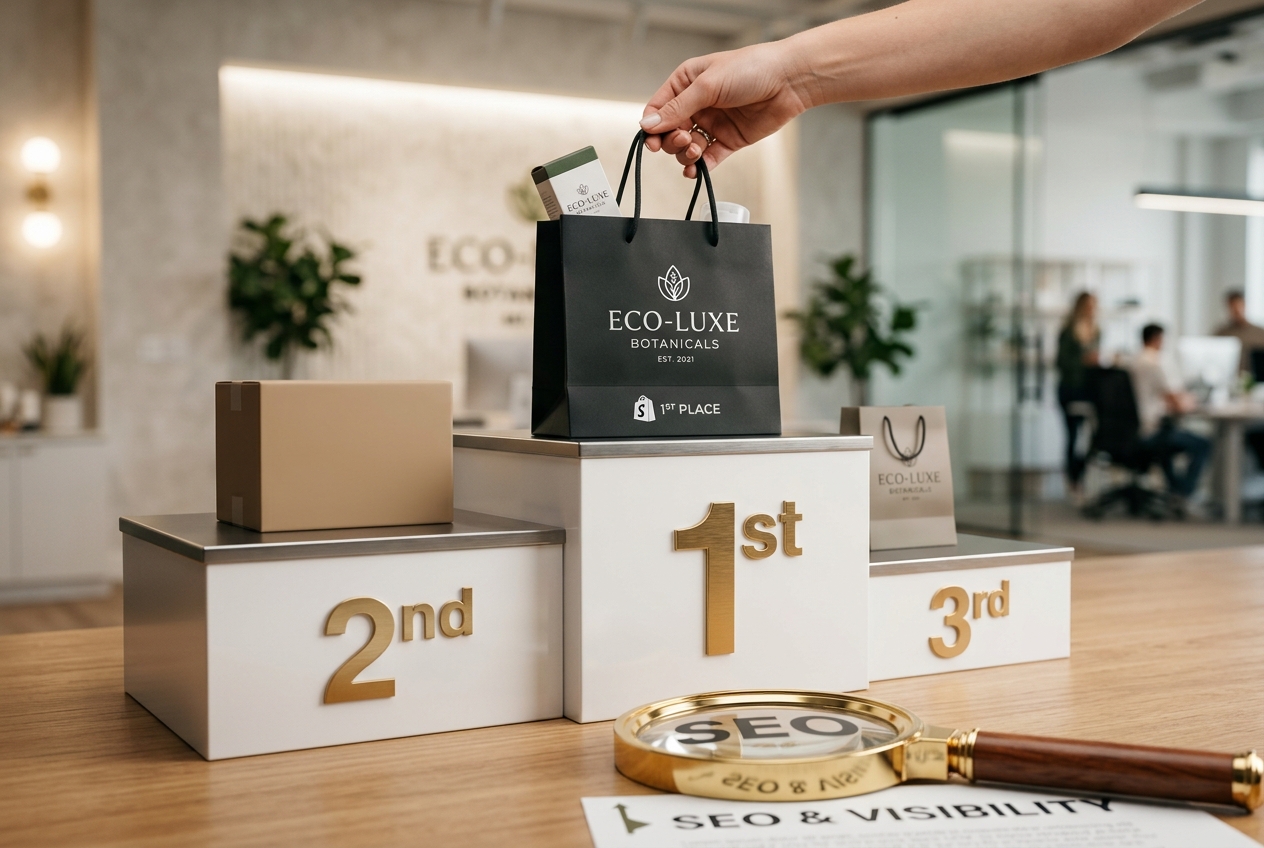
Human shoppers are the main targets for Shopify stores, there’s no doubt about that. But, just like many other elements of modern search, the clean design, good product photos, and readable descriptions characteristic of them are now the bare minimum. Say someone asks “what’s the best sustainable water bottle brand?” not to Google, but to ChatGPT. Something different happens behind the scenes. ChatGPT and other AI don’t browse your store the way a customer does. It scans for structured signals it can extract, verify, and trust. If your Shopify store doesn’t speak that language, it won’t be mentioned, regardless of how polished it looks to human visitors.
Industry reporting indicates that orders originating directly from AI platforms like ChatGPT, Gemini, and Perplexity have grown dramatically on Shopify. That’s why entity optimisation and Shopify schema markup are becoming necessities, not just nice-to-haves.
Quick Answer
Shopify stores win AI visibility by defining clear entities — brand, product category, use-case, and key attributes — that AI systems can map, verify, and cite confidently. Entity optimisation on Shopify combines structured product descriptions, schema markup on key page types, and consistent brand signals that connect your store to recognisable concepts AI already understands.
What “Entity Optimisation” Actually Means for a Shopify Store
The term sounds more complicated than it really is. An entity is anything AI can identify as a distinct, knowable thing. That could be your brand, a product category, a specific SKU, a use case, an ingredient, a material. When AI encounters your store, it tries to connect these things to a broader knowledge graph. If those connections are clear, it can cite you. If they’re vague or inconsistent, it moves on.
Traditional Shopify SEO focused on keyword matching. You put “waterproof hiking boots” in your title tag and hoped Google matched it to the same phrase in someone’s search. AI search doesn’t work that way. AI systems don’t read pages line by line. They rely on structured data to understand what information means and how it connects. Keyword density still matters, but it’s entity relationships that determine whether a page gets cited in an AI-generated answer.
For Shopify merchants, this means three things need to be true. Your brand entity needs to be clearly defined. Your products need to be structured as machine-readable data objects. And your collections need context that goes beyond a grid of SKUs.
Your Brand Entity: The Foundation Everything Else Builds On
Before AI can confidently recommend your products, it needs to understand who you are as a brand. This is what keeps most Shopify stores from the visibility they deserve.
A brand entity isn’t just your About page copy. It’s a structured, consistent set of signals that tells AI a few things. It says this brand exists, it operates in this category, it serves this customer, and here’s verifiable proof. The primary vehicle for establishing this on Shopify is Organisation schema, placed on your homepage, combined with consistent name, address, and phone data across your site and any external profiles.
At Premiere Creative, we audit Shopify stores for DTC brands across New Jersey and the broader ecommerce market, and brand entity gaps are among the most common issues we find. A store might have excellent product pages but no Organisation schema at all, which means AI has no reliable, machine-readable confirmation of who is selling these products. Without that anchor, the product data has no brand to connect to. Without anything to latch onto, AI has nothing to cite.
The key fields to define in your Organisation schema: brand name, legal name if different, primary product category, URL, logo, and official social profiles. These become the anchor that all product and collection entities connect to.
Product Entities: What Your PDPs Are Missing, and Why It Matters for Shopify Schema Markup
Entity work gets more specialized on the product pages. Shopify generates some basic structured data for product pages. But that’s the issue. It’s too basic to really help. The default Shopify schema tells AI what your product costs. It doesn’t tell AI what your product is, who it’s for, what problem it solves, or why it’s worth recommending.
The entity-rich PDP that earns citations has a few things the default template doesn’t.
Attribute completeness matters first. Every product attribute relevant to a buyer should appear in both the readable description and the schema. That means material, size range, weight, compatibility, certification, country of origin. AI systems use these attributes to match products to specific, detailed queries. “Best PFAS-free non-stick pan under $80” is the kind of query a product entity can answer. But those attributes need to be there for that to happen.
Use-case mapping comes next. A description that only says what the product is will lose to one that also explains who uses it and when. “Our whey protein is designed for post-workout recovery in athletes managing lactose sensitivity” provides information on use case and customer segment. That’s two entity connections a plain feature list doesn’t provide.
FAQ blocks on the PDP are still among the most underleveraged elements in Shopify ecommerce SEO. In 2025, both Google and Microsoft publicly confirmed they use schema markup for generative AI features, and ChatGPT confirmed it uses structured data to determine which products appear in its results. FAQPage schema on a product page, answering three to five specific buyer questions, gives AI a directly extractable, verified answer source. One DTC wellness brand we worked with added FAQ schema to their top 30 PDPs and saw their first AI Overview citations for category-level queries within six weeks. The structural change was the variable.
Collection Pages: Where Most Shopify Stores Leave Category-Level AI Visibility Behind
Collection pages on Shopify tend to get treated as navigation tools, a grid of products with a short intro paragraph at the top. That’s a missed entity opportunity, because AI frequently fields category-level queries.
A collection page that earns AI citations does something different. It defines the category itself. What is this collection? Who is it for? What criteria should a buyer use to choose between the products in it? A “Skincare for Oily Skin” collection page that explains what oily skin needs, which ingredients are most effective, and how the products in the collection address those needs has a realistic shot at being cited when someone asks “what are the best DTC skincare brands for oily skin.” A collection page that just lists products doesn’t.
The schema type to install here is ItemList, combined with the same Product schema used on individual PDPs. Shopify doesn’t generate ItemList schema by default. It requires either a custom Liquid implementation or a schema app. Both are manageable and the payoff in category-level visibility is worth the setup time.
The Entity Signals AI Looks For: A Practical Audit Checklist
There’s no universal checklist of technical requirements here. Instead, think of these four questions as supplements to the practical guide to DTC AI SEO. Your Shopify store should be able to answer these via structured data alone, and AI shouldn’t have to infer anything.
Does your homepage identify your brand? Organisation schema establishes brand identity as a machine-readable entity. Shopify doesn’t add this automatically, so most stores don’t have it.
Do your product pages explain what the product is and who it’s for? Complete Product schema goes beyond the Shopify default to include attributes, use cases, and FAQPage markup. Tools like JSON-LD for SEO handle most of this without custom code.
Is your product naming consistent? AI systems cross-reference product entity signals across your site. If a product is “Matte Lip Tint” in the title, “Lip Colour” in the description, and “Lip Product” in the meta, those inconsistencies weaken the entity signal. Pick one name and use it everywhere.
Do your pages tell AI where they sit in your site structure? Breadcrumb schema helps AI understand the relationship between brand, collection, and product. Shopify themes often include breadcrumb navigation visually but don’t generate the corresponding BreadcrumbList schema. Verify this with Google’s Rich Results Test.
Key Takeaways
- Entity optimisation means structuring your Shopify store so AI systems can identify, map, and verify your brand, products, and categories as distinct data objects
- Shopify’s default schema covers basic product data but leaves brand identity, use cases, FAQs, and collection entities largely unaddressed
- Organisation schema on the homepage establishes brand entity clarity and is not automatically generated by Shopify
- Complete Product schema should include attributes, use-case context, and FAQPage markup — not just name and price
- Collection pages need entity-defining content and ItemList schema to compete for category-level AI queries
- Consistent product naming across all on-page elements strengthens entity signals; inconsistency weakens them
- Both Google and ChatGPT have confirmed they use structured data to determine which brands and products appear in AI-generated results
Frequently Asked Questions
Does Shopify automatically add schema markup to my store?
Shopify generates basic Product schema on product pages, covering name, price, image, and availability, but it does not add Organisation schema, FAQPage schema, ItemList schema for collections, or complete attribute-level product data. These are the gaps where most Shopify stores lose AI citation eligibility.
What’s the difference between entity optimisation and regular Shopify SEO?
Regular Shopify SEO optimises for keyword rankings in traditional search results. Entity optimisation structures your store’s data so AI systems can understand the relationships between your brand, products, and categories, and cite them in generative answers. The two approaches are complementary but require different technical implementations.
Does my Shopify store need a developer to add schema markup?
Not necessarily. Apps like JSON-LD for SEO handle most schema types without custom code. For stores with complex catalogs or specific attribute requirements, a developer using custom Liquid provides more control, but the foundational schema types are accessible without one.
How do I check whether my Shopify schema markup is working?
Use Google’s Rich Results Test and the Schema.org validator to check individual pages. Google Search Console also surfaces structured data errors and warnings under the Enhancements section. Check these before and after any schema implementation.
If Your Store Can’t Be Read by AI, It Won’t Be Recommended by AI
Entity optimisation isn’t a one-time project. New products need entity-complete descriptions. New collections need defining content and schema. Brand signals need to stay consistent as the catalog grows. But the structural work — Organisation schema, complete Product schema, collection entity content, FAQ blocks on PDPs — pays dividends across every AI surface simultaneously. The same signals that make your store citable in Google AI Overviews also help ChatGPT, Gemini, and Perplexity understand and recommend your products.
Premiere Creative audits Shopify stores specifically for AI citation readiness, covering schema coverage, entity consistency, and the content gaps that keep well-built stores invisible in AI results. That’s where the work starts.